

.
Having worked with patients struggling with emotionally-based disorders (EBDs) for over 25 years, I often demarcate anxiety from depression and vice versa. This has been done for clinical reasons, as effective treatment has been simpler by targeting each diagnosis as discrete mental disorders. The clinical reality is much more complex, as anxiety and depression are aligned in many ways. In a paper discussing the overlap of anxiety, depression, and obsessive-compulsive disorder (OCD), it was noted that there is a lifetime anxiety comorbidity of 58% among people with major depression (Kessler et al., 1996; as cited in Goodwin, 2015, p. 250). Goodwin also described a common distress dimension and negative affectivity (i.e., a diathesis toward fear, sadness, guilt, and similar emotions) to explain the overlap, and yet, low positive affect and anhedonia were more specific to depression, while Clark and Watson (1991; as cited in Goodwin, 2015, p. 251) noted that physiological hyperarousal (e.g., shortness of breath and dizziness) was more specific to anxiety. Mechanistically, Goodwin (2015) also discussed common neuroimaging and behavioral trait mechanisms, noting that neuroticism is a shared risk factor in triggering the onset of anxiety disorders, OCD, and major depression since it is 40% heritable and is considered a major internalizing factor underlying a wide range of emotional disorders. From a neuroimaging perspective, Etkin and Schatzberg (2011; as cited in Goodwin, 2015, p. 255) also described how both anxious and depressed patients exhibit common involvement of the ventral cingulate and amygdala, and that both disorders are characterized by a hypersensitivity to negative cues, especially negative facial information.
In a similar paper, Hettema et al. (2006; as cited in Kalin, 2020, p. 365) noted that the personality trait of neuroticism is associated with the development of both anxiety and depression, and that the genetic risk of neuroticism is also linked to the risk of developing internalizing disorders. Other data obtained by Fava et al. (2004; as cited in Kalin, 2020, p. 365) showed a comorbidity of 53% at the symptom level between patients with major depression and significant anxiety. From a neural circuit perspective, both anxiety and depression disorders are characterized by common neural circuit disruptions in prefrontal-limbic pathways that regulate emotional regulation (Kovner, Oler, & Kalin, 2019; as cited in Kalin, 2020, p. 365).
Clinically, my treatment approach aims to treat EBDs by lessening symptoms, improving functionality, and the quality of life of the patients I serve, no matter the precise diagnosis or diagnoses provided. Although I often use individual orthomolecular and botanical treatments in combination, an approach that has made this aim less complicated, yet no less effective, has been to provide patients with a broad-spectrum micronutrient (BSM) supplement. It is worth sampling some of the published literature on BSMs, as applied to symptoms of anxiety and/or depression, since positive data has steadily accumulated since the early 2000s. It could be argued that the BSM approach is not orthomolecular, owing to its shotgun method, but I strongly disagree. Given the definition of orthomolecular psychiatric therapy as originated by the late preeminent scientist, Linus Pauling, in his 1968 seminal paper in the journal Science, he defined it as “treatment of mental disease by the provision of the optimum molecular environment for the mind, especially the optimum concentrations of substances normally present in the human body” (p. 265). There is nothing un-orthomolecular about providing therapeutic amounts of BSMs to assuage mental diseases (now, commonly referred to as mental disorders), especially since BSMs increase the concentration of some 40 micronutrients in the body and brain, thus facilitating therapeutic amounts of substances normally present in the human body. In Table 1, I have summarized relevant studies on BSMs and their specific symptomatic impact on anxiety and/or depression.
Table 1. Impact of Broad-Spectrum Micronutrients (BSMs) on Symptoms of Anxiety and/or Depression: A Sampling of Relevant Studies
From the data as noted in Table 1, it is clear that BSMs produce helpful therapeutic effects. Some nuances are worth noting here. In the Rucklidge et al. (2012) study, both the high- and low-dose BSM groups showed practically the same results, suggesting that patients can benefit from 4 capsules daily as opposed to 8 capsules daily. This low-dose strategy (4 capsules/day) of BSMs was later confirmed by Kaplan et al. (2015) in a similar study involving participants having experienced significant psychological stress from a natural disaster. Another study by Kimball et al. (2018) showed that even one pill daily of BSMs when combined with vitamin D3, vitamin B12, probiotics, and omega-3 essential fatty acids can favorably impact depression and anxiety, but more notably among individuals with severe/extreme depression. In the Blampied et al. (2023) study, participants took 4 capsules three times daily, but the 10-week results did not show statistically significant improvements in anxiety and depression when BSMs were compared to placebo. This study did find, however, stronger effects from BSMs among younger participants, participants with prior psychiatric medication use, or from lower socioeconomic status. Lastly, the naturalistic study by Coet et al. (2025), which was an extension of the above-noted study, showed a sustained long-term (i.e., one-year) benefit from BSMs at an average lower daily dose of 7.3 capsules, suggesting that 12 capsules daily is likely unnecessary when attempting to moderate symptoms of anxiety and depression. In all the cited studies, the adverse effects were not serious and the majority of participants tolerated the BSMs very well, especially since the drop-out rates were very low.
Mechanistically, BSMs possess pleiotropic effects that go beyond the moderation of anxiety and depressive symptoms (Figure 1). In a systematic review by Rucklidge and Kaplan (2013), they highlighted the following brain mechanisms as likely explanations for the observed positive effects of BSMs on brain function: (1) providing sufficient micronutrients to assist enzymes “with drastically reduced activity” to become “so supersaturated with the necessary cofactors that near-normal function is restored” (p.50); (2) maintaining optimal homocysteine levels to ensure proper cellular function; (3) improved energy metabolism of neuronal and glial cells via the production of adenosine triphosphate (ATP) and augmented mitochondrial function; and (4) moderating the effects of gastrointestinal inflammation and/or gut sensitivities. Rucklidge et al. (2021) reported similar brain mechanisms for the beneficial clinical outcomes achieved from BSMs, but with the addition of environmental toxin protection, especially from toxins that adversely impact brain health, such as phthalates, glyphosate, and other environmental chemicals/pollutants. In a publication addressing the role of BSMs in helping with emotional dysregulation, Villagomez et al. (2023) describe the value of multiple vitamins and minerals with supporting brain metabolism, contributing to neurotransmitter production, modulating cell signalling and gene expression, participating in neurodevelopment, and possessing anti-inflammatory effects.
Figure 1. Borad-Spectrum Micronutrient (BSM) Mechanisms in Emotianally-Based Disorders
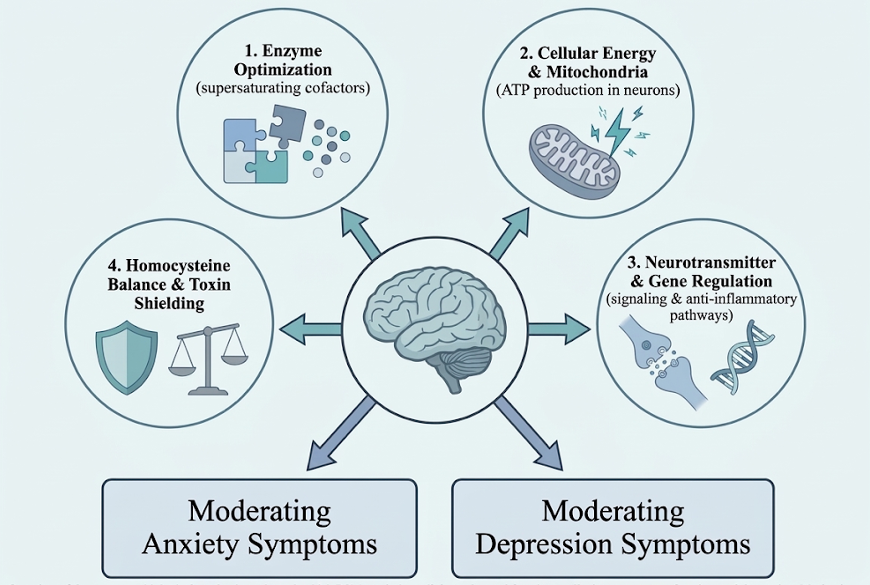
Overview of the neurobiological meachanisms through which BSMs optimize cellular and neural function to alleviate symptoms of anxiety and depression. Mechanisms include enzyme supersaturation with cofactors, neuronal ATP production, neurotransmitter and gene regulation, and homocysteine balance paired with neurotoxin protection.
Given the journal’s keen interest in case reports, the evidence to date suggests a therapeutic advantage when adding BSMs to the overall treatment plan of any patient struggling with EBDs. While BSMs are not curative, they increase the prognostic odds of achieving good clinical outcomes, especially since the adverse effects are minimal and the likelihood of moderating symptoms is close to 50% and sometimes more. I hope this editorial will stimulate the use of BSMs in patients we serve.
Wishing you and your patients the best of health as the end of 2026 approaches.
Warm regards

Jonathan E. Prousky, ND, MSc, MA
Editor